

Magnesia Chrome Brick
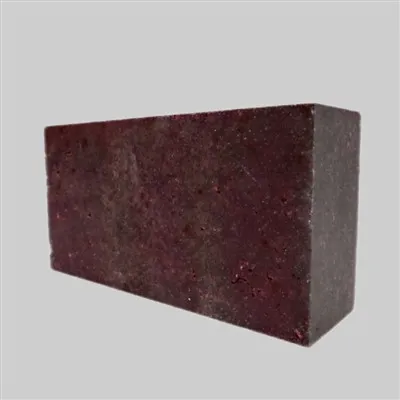
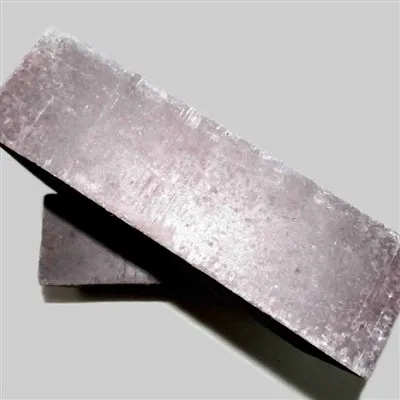
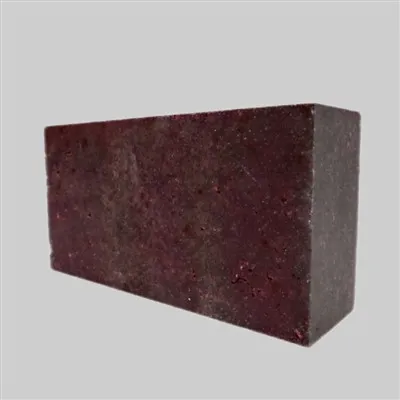
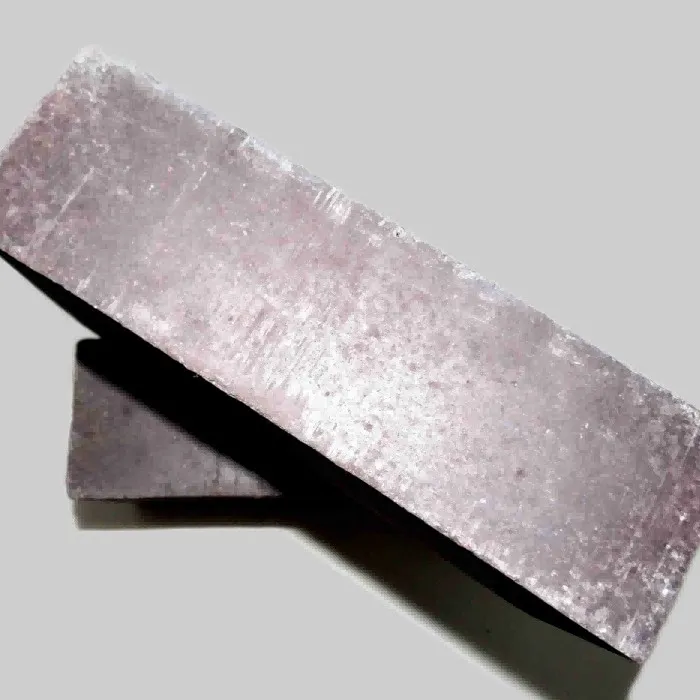
Magnesia-chrome bricks are made from high purity magnesia and chrome with periclase and spinel as main mineral components of refractory products. Common Magnesite chrome brick is made by sintered magnesia and refractory level chrome ore as raw materials, in which purity of magnesia raw material must be high as possible. The bricks are molded at high pressure and fixed in high temperatures.
Advantages of Magnesia Chrome Brick
High-temperature resistance
Magnesia chrome bricks are capable of withstanding high temperatures. They can withstand temperatures up to 1800°C (3272°F) or higher, depending on the specific composition and manufacturing process.
Corrosion resistance
Magnesia chrome bricks have excellent resistance to alkaline slags and basic environments. They are commonly used in applications where they come into contact with molten metals, such as steelmaking, non-ferrous metal smelting, and refining processes.
Erosion resistance
Magnesia chrome bricks exhibit good erosion resistance against abrasive materials and high-velocity gas flows. They can withstand the erosive forces encountered in various industrial processes.
Thermal shock resistance
Magnesia chrome bricks have good thermal shock resistance, allowing them to withstand rapid temperature changes without cracking or spalling. This property is important in applications where thermal cycling occurs.
High mechanical strength
Magnesia chrome bricks possess high mechanical strength, enabling them to withstand mechanical stress and loads in high-temperature environments. They have good resistance to deformation and can support heavy loads.
Application versatility
Magnesia chrome bricks find applications in a wide range of industries, including steelmaking, cement, non-ferrous metals, glass, and petrochemicals. They are used in furnaces, kilns, ladles, converters, and other high-temperature equipment where resistance to corrosion and erosion is critical.


Why Choose Us
Our factory
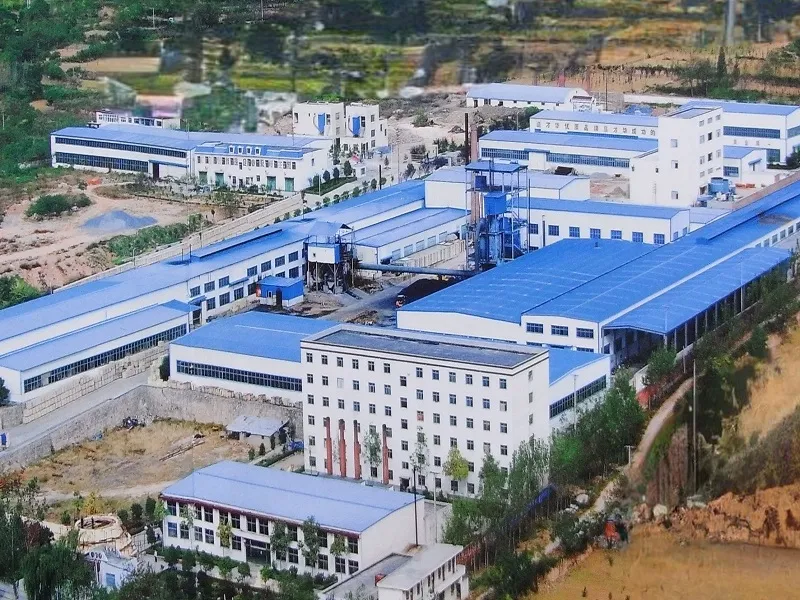
Factory established in 1984, International business department established in 2010, factory with 10000 m2 area.
Advanced equipment
Sets of 1000 tons brick machine, 10 sets of 630 tons brick machine, 2 sets of 180m high temperature tunnel kilns, complete set of physical and chemical index testing equipment.
Our service
Free products design, free technological supporting, free installation guidance, 18 month quality guarantee.
Our product
Ch refractories is professional manufacturer of fire bricks, Mortar, Pre-cast, Pre shape, Insulation products, Castable, Functional Products for Iron & Steel, Cement, Glass, Power & Petrochemical Industries. Moreover, CH REFRACTORIES also manufacturing and exporting refractory cement A600 A700 A900 CA70, Bauxite and other refractories raw material to all of the world.
Main Uses of Magnesia Chrome Bricks
Metallurgical industry
Magnesia-chrome bricks are widely used in high-temperature equipment in the metallurgical industry, such as steel converters, electric furnaces, and smelting furnaces. They can be used in areas such as linings, furnace floors, furnace walls and furnace roofs to provide refractory protection and withstand erosion and wear under high temperature conditions.
Chlor-alkali industry
Equipment such as electrolyzers and evaporators in the production process of the chlor-alkali industry need materials that can withstand high temperatures and corrosion. Magnesia-chrome bricks are widely used in these equipment, providing excellent fire resistance and corrosion resistance, ensuring long-term stable operation of the equipment.
Oil refining and chemical industry
In the oil refining and chemical industry, magnesia-chrome bricks are often used in high-temperature equipment such as catalytic cracking units, hydrogenation units, reforming units and furnaces. They withstand high temperatures, corrosive gases and chemicals and provide reliable fire protection.
Glass industry
Glass furnaces are the core equipment in the glass industry, which are required to withstand extremely high temperatures and chemical erosion. Magnesia-chrome bricks are widely used in the inner lining, cooling zone and melting area of glass furnaces to maintain stable refractory performance and long service life.
Power industry
In the power industry, magnesia-chrome bricks are often used in high-temperature equipment such as boilers, burners, chimneys and hot blast stoves. They can withstand high temperature and flue gas erosion, and provide effective fire protection to ensure the normal operation and safety performance of equipment.
Other industries
In addition, magnesia-chrome bricks are also widely used in cement kilns, ceramic kilns, welding furnaces, carbonization furnaces, aluminum electrolytic cells and other fields. Its excellent fire resistance and corrosion resistance make it an important high temperature refractory material.
How to Reduce the Porosity of Magnesia Chrome Brick
Raw material selection
The choice of raw materials is crucial in determining the porosity of magnesia chrome bricks. Opt for high-quality magnesia and chrome ore with low impurity levels. Selecting materials with finer particle size distribution ensures better particle packing during the brick manufacturing process, reducing pore formation.
Adjusting the composition
The composition of magnesia chrome bricks can be modified to reduce porosity. Increasing the magnesia content and decreasing the chrome oxide content can improve the brick's density and reduce voids. However, it's important to strike a balance, as excessive magnesia can lead to increased thermal expansion and potential cracking.
Particle size optimization
Controlling the particle size distribution of the raw materials is essential to minimize porosity. Fine particles fill the gaps between coarser particles, resulting in a denser structure. To achieve this, grinding and milling processes can be employed to reduce the particle size of magnesia and chrome ore before mixing.
Proper mixing and homogenization
Thorough mixing and homogenization of the raw materials ensure uniform distribution and reduce the formation of air pockets. This can be achieved through mechanical mixing techniques such as ball milling or pug milling. The addition of binders or additives can also enhance the homogeneity and reduce porosity.
Optimized firing schedule
The firing schedule during the brick manufacturing process significantly impacts the final porosity. A controlled and optimized firing cycle helps in achieving higher density and reduced porosity. Slow heating rates, appropriate soaking temperatures, and extended holding times at peak temperature allow for better sintering and elimination of residual porosity.
Pressure techniques
Applying pressure during the brick formation process can effectively reduce porosity. Pressure molding techniques, such as dry pressing or isostatic pressing, compact the raw materials and eliminate voids. This results in higher density and improved mechanical properties of the magnesia chrome bricks.
Advanced firing atmospheres
The choice of firing atmosphere can influence the porosity of magnesia chrome bricks. Utilizing reducing or controlled atmospheres during firing can minimize the formation of gaseous byproducts, which can lead to porosity. Inert gases or controlled gas mixtures create an environment that promotes densification during sintering.
Post-treatment techniques
Post-treatment processes can be employed to further reduce porosity. Techniques such as hot isostatic pressing (hip) or secondary firing at elevated temperatures can help close any remaining pores and enhance the overall density of the bricks. However, it's important to evaluate the impact of these techniques on other properties of the bricks, such as thermal expansion.
Types of Magnesia Chrome Bricks
Ordinary magnesia chrome brick
Ordinary magnesia-chrome bricks are generally produced from sintered magnesia (MgO mass fraction between 89% and 92%) and refractory grade chrome ore as raw materials. Due to the large amount of impurities, the refractory grains are bonded with silicate. Ordinary magnesia-chrome bricks have simple production process and low price, and are widely used in cement rotary kilns (Cr2O3 mass fraction rarely exceeds 14%), glass kiln regenerators, steelmaking furnace linings, permanent layers of refining ladles, nonferrous metallurgical furnaces, Lime kiln, mixed iron furnace and refractory high temperature kiln lining, etc.
Directly combined with magnesia-chrome bricks
The main difference between the production process of directly combined magnesia-chrome bricks and ordinary magnesia-chrome bricks is that the former uses raw materials with less impurity content and is fired at a relatively high temperature. For the production of magnesia directly combined with magnesia-chrome bricks, the mass fraction of MgO is generally greater than 95%, preferably greater than 97%, the particle volume density is about 3.25g/cm3, and the mass fraction of SiO2 in chrome ore is generally limited to below 3%. When using chrome concentrate, the SiO2 mass fraction can be lower than 1.0%. According to different needs and uses, sometimes 1–2 kinds of magnesia and 1–2 kinds of chrome ore can be used for batching. The cement kiln is directly bonded with magnesia-chrome bricks, generally magnesia is used as fine powder and part of the granular material, and chrome ore is used as the granular material, and the mass fraction of Cr2O3 is 3% to 14%.
Electrofusion recombination (semi-recombination) magnesia-chrome brick
Usually people call the magnesia-chrome brick made of fused magnesia-chrome sand a rebonded magnesia-chrome brick, and the products that add part of fused magnesia-chrome sand are called semi-rebonded magnesia-chrome bricks. Starting from the characteristic of direct combination of high-temperature crystal phase in microstructure, rebonded and semi-rebonded magnesia-chrome bricks are direct bonded bricks with higher direct bonding rate. Due to the direct combination of magnesia-chrome bricks, recombined (semi-recombined) magnesia-chrome bricks have the characteristics of low impurity content and high-temperature (ultra-high temperature) firing, and these products are also called high-temperature fired (ultra-high temperature fired) magnesia-chrome bricks. brick. The use of synthetic magnesia-chrome sand is the technological basis for the production of recombined and semi-recombined magnesia-chrome bricks.
What Is the Composition of Magnesia Chrome Brick?
Composition of fused cast magnesia-chrome bricks
Fused-cast magnesia-chrome bricks are refractory products made from magnesia and chrome ore through electric melting and casting. The production process of fused cast magnesia-chrome bricks. It is characterized by large and isolated pores, dense products, high strength, corrosion resistance, and sensitivity to temperature changes. The chemical properties of magnesia-chrome bricks are alkaline. Compared with magnesia bricks and slabs, they have good thermal shock resistance, stable volume at high temperatures, and high load softening temperature.
Directly combine the components of magnesia-chrome bricks
Directly bonded magnesia-chrome bricks are made by combining sintered magnesia and chromite. It is required that the SiO2 content of the raw material is low, and it is fired at a high temperature above 1700 ° C to form a direct bond between periclase and chromite particles. The typical physical and chemical properties of directly bonded magnesia-chrome bricks are: MgO 82.61%, Cr2O3 8.72%, SiO2 2.02%, apparent porosity 15%, and bulk density 3.08g/cm3. The compressive strength is 59.8MPa, the load softening temperature is 1765°C, the thermal shock resistance is 1100°C (water-cooled) 14 times, and the flexural strength is 8.33MPa.
Composition of silicate-bonded magnesia-chrome bricks
Silicate-bonded magnesia-chrome bricks are made by sintering magnesia and chrome ore as raw materials, blending them in appropriate proportions and firing them at high temperature. The mineral composition of the product is periclase, spinel and a small amount of silicate. The production of silicate-bonded magnesia-chrome bricks uses brick-making magnesia and general refractory grade chrome ore as raw materials, Si02<4% in magnesia, Mg0>90%, Cr203 in chromium ore 32%-45%, and sulfite as the main material. After binder, kneading and forming, it is fired at about 1600°C. In order to prevent abnormal expansion of products during firing, a weak oxidizing atmosphere must be maintained in the kiln. The chemical composition of the product: Si02 2.98%-4.50%, MgO 61.75%-72.69%, Cr203 10.04%-14.90%. Physical properties: apparent porosity 18%-21%, normal temperature compressive strength 36.1–50.OMPa, load softening temperature 1600–1640℃.
Combining the composition of magnesia-chrome bricks
Recombined magnesia-chrome bricks are made by sintering fused magnesia-chrome sand as raw material. Fused magnesia-chrome sand has poor sinterability, and the product is a fine-grained matrix with uniform distribution of pores and tiny cracks. It is more sensitive to sudden temperature changes than fused cast bricks. The high-temperature performance of the product is between the fused cast brick and the direct bonded brick. The typical physical and chemical properties of combined magnesia-chrome bricks are: MgO 68%, Cr203 15%, SiO2 3%, apparent porosity 14%. Bulk density 3.20g/cm3, compressive strength 52.8MPa, load softening temperature 1740℃, flexural resistance Strength 7.86MPa.
Composition of semi-recombined magnesia-chrome bricks
Semi-recombined magnesia-chrome bricks are made from fused magnesia-chrome sand and magnesia, chromite or pre-reacted magnesia-chrome sand. The products have some characteristics of recombined magnesia-chrome bricks and directly combined magnesia-chrome bricks or pre-reaction magnesia-chrome bricks. The typical physical and chemical properties of semi-recombined magnesia-chrome bricks are: MgO 71.58%, Cr2O3 16.45%, SiO2 2.75%, apparent porosity 13%. Compressive strength 46.7MPa, load softening temperature 1760℃, flexural strength 9.09MPa.
Composition of pre-reaction magnesia-chrome bricks
Pre-reacted magnesia-chrome bricks are made of all or part of pre-reacted magnesia-chrome sand. The production cost is lower than that of recombined magnesia-chrome bricks. The partial reaction between magnesia and chromite is completed when the clinker is calcined, so the apparent porosity of the product is lower than that of the directly bonded brick with the same composition, and the high temperature strength is high. The typical composition of pre-reaction magnesia-chrome bricks is: MgO 62.8%, Cr2O3 15.3%, SiO2 3.25%, apparent porosity 17%, compressive strength 51.3MPa, load softening temperature 1650℃.
Composition of unburned magnesia chrome bricks
Unburned magnesia-chrome bricks are made of sintered magnesia and chromite as raw materials, adding a small amount of chemical binder, and heat-treating at a lower temperature to harden the product. Some can harden the product at normal temperature, and some need to be heated to an appropriate temperature to make the product have a certain strength. When the product is used at high temperature, it will form a ceramic bond or a high temperature resistant phase.
Performance and Production Process of Magnesia Chrome Bricks
Magnesia chrome brick have fewer impurities. After high-temperature and ultra-high-temperature firing, the glass phase is concentrated in the triangular area of the crystal phase, and the crystal phase and the crystal phase are directly combined. This type of magnesia-chrome brick has low porosity, high compressive strength, strong wear resistance, good corrosion resistance, thermal shock resistance, and spalling resistance.
When it comes to the production process of direct-bond magnesite chrome bricks, firstly start from direct-bond magnesite chrome brick, it refers to refractory products that are directly combined with periclase and magnesite chrome spinel as the main crystal phase. The brick is made of high-purity sintered magnesia and chromite with sio2 less than 2% as raw materials and sintered at high temperatures. Direct bonded magnesia chrome bricks are products made from high-purity or sub-high-purity sintered or fused magnesia and chrome concentrate. Direct bonding refers to a bond produced by direct contact between solid-phase grains. The brick is made of high-purity sintered magnesia and chrome concentrate with sio2<2% as raw materials and is sintered at high temperatures. The degree of direct bonding of the product increases with the decrease of sio2 content and the increase of firing temperature.
When producing magnesia chrome brick, chrome ore with low sio2 content should be selected as much as possible, because low sio2 content is beneficial to improve the high-temperature performance of such refractory bricks. By comparing the properties of various magnesia-chrome bricks, it is found that the load-softening temperature of magnesia chrome brick produced by selecting high-purity sio2 (low content) chrome ore is high. Of course, magnesia-chrome bricks with low sio2 content also need to be fired at high temperatures or low temperatures. As many research works have pointed out. Although there is no obvious dividing line between silicate-bonded (ceramic-bonded) magnesia-chrome bricks and direct-bonded magnesia-chrome bricks, there is actually in magnesia-chrome bricks fired below 1500 °c. Only when the firing temperature exceeds 1550 °c, their direct bonding will increase.
Since the current magnesia-chrome bricks are all fired above 1500°c, they are only different in the degree of direct bonding. This shows that the primary condition for the production of direct bonded magnesia-chrome refractory bricks is firing at high temperatures or low temperatures. For example, magnesia-chrome bricks containing 1.5% sio2 are fired at 1800 ° c, compared with other magnesia-chrome bricks, because the amount of direct bonding of the high refractory phase increases. However, too high a firing temperature will also cause deformation and upside-down of such magnesia-chrome bricks and increase the amount of waste refractory bricks.
In order to reduce the waste products caused by firing deformation, the measures taken in the process technology are to reduce the sio2 content in the ingredients (especially the sio2 content in the chrome ore). The amount of direct bonding in magnesia-chrome bricks increases significantly with the decrease in sio2 content. This is because when the sio2 content is reduced, the silicate layer in the material is replaced by the direct combination between the crystals of the high refractory phase.
Our Factory
Factory established in 1984, International business department established in 2010. Factory with 10000 m2 area, 120 employees including 20 professional engineers. CH REFRACTORIES is professional manufacturer of fire bricks, Mortar, Pre-cast, Pre shape, Insulation products, Castable, Functional Products for Iron & Steel, Cement, Glass, Power & Petrochemical Industries. Moreover, CH REFRACTORIES also manufacturing and exporting refractory cement A600 A700 A900 CA70, Bauxite and other refractories raw material to all of the world.
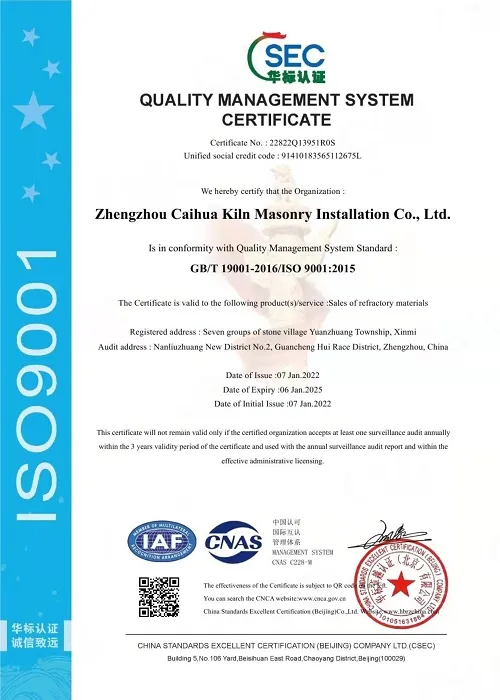
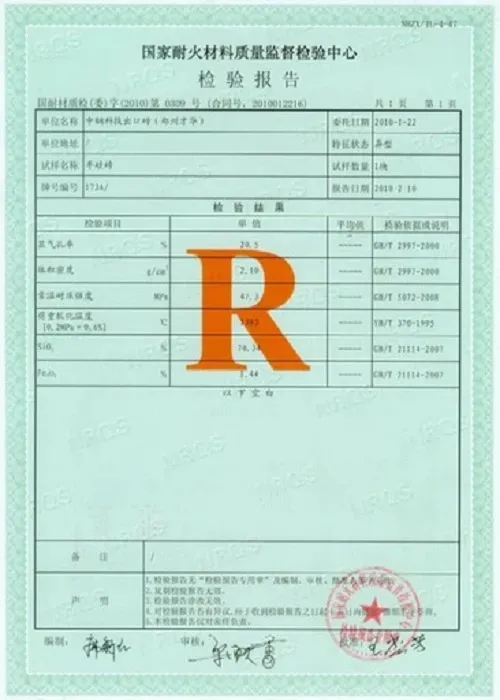
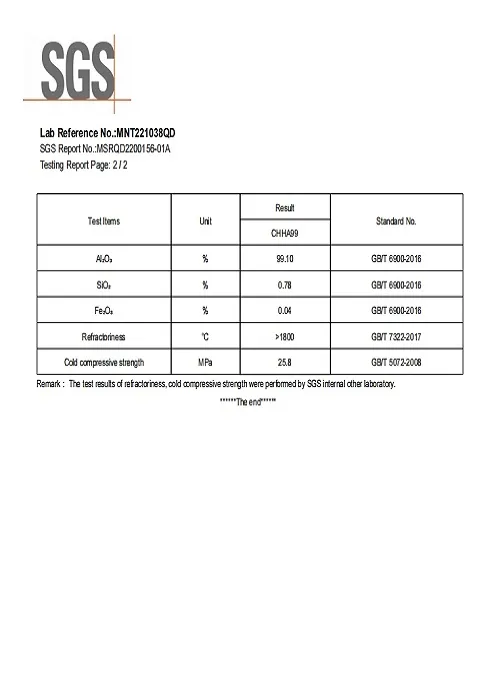
Certificate
FAQ:
Q: What are magnesia chrome bricks?
Q: What are the common shapes of magnesia chrome bricks?
Q: How do you determine the appropriate thickness of magnesia chrome bricks for a furnace lining?
Q: How do you repair damaged magnesia chrome brick linings?
Q: Are there any safety precautions to consider when working with magnesia chrome bricks?
Q: How do you assess the quality of magnesia chrome bricks?
Q: Can magnesia chrome bricks be used in contact with molten metals?
Q: How do you determine the service temperature of magnesia chrome bricks?
Q: How do you extend the service life of magnesia chrome brick linings?
Q: Are there any environmental considerations when using magnesia chrome bricks?
Q: Can magnesia chrome bricks be used in non-ferrous metal applications?
Q: What are the key factors to consider when selecting magnesia chrome bricks for a specific application?
Q: What are the main applications of magnesia chrome bricks?
Q: What are the key properties of magnesia chrome bricks?
Q: How are magnesia chrome bricks classified?
Q: What is the typical composition of magnesia chrome bricks?
Q: How are magnesia chrome bricks manufactured?
Q: What are the advantages of using magnesia chrome bricks?
Q: How do magnesia chrome bricks compare to other refractory materials?
Q: How should magnesia chrome bricks be stored?
We're well-known as one of the leading magnesia chrome brick manufacturers in China. Please rest assured to buy customized magnesia chrome brick at competitive price from our factory. Contact us for more cheap products.
fire brick with good chemical resistance, fire brick with excellent refractory properties, metallurgical vibration damping agents